Showing posts with label Vietnam War. Show all posts

Friday, September 3, 2010

Vietnam...the other war. M16 vs AK47, winner is?


During the entire Vietnam Conflict, 2 legendary assault rifles made their marks on the battlefield.
The American GIs and the ARVN ( South Vietnamese troops) relied heavily on their standard issue M16 assault rifle.
The North Vietnamese and the Vietcong soldiers best weapon was the USSR supplied AK 47.

Both sides in the conflict had ample opportunity to test their gun under the most extreme fighting conditions imaginable...heat, humidity, the monsoon season, swampy and muddy conditions, grime and choking dust, dirt and blood...
And both sides also captured each other's guns and ammo.


[ This is a standard Russian made AK 47 ]


The AK 47
AK stands for Automatic Kalashnikov. 47 was the year it was first produced...1947.
The inventor was Mikhail Kalashnikov who was wounded in a battle towards the end of WW2. He was recuperating in a hospital in Russia and decided to tinker around with the earlier versions of the Russian gun. Soon as he recovered, he submitted his improved design in a contest
and the rest was as they say ..history.

The AK47 is designed for easy use and can be produced cheaply. It is rugged, battle-proven, easy to clean and maintain and can deliver a powerful impact in rapid-fire, sub-machine gun mode.
It uses the 7.56mm caliber ammo that is bigger and deadlier than the M16 bullet.

Unk Dicko is not an expert on firearms.
As mentioned in some of my earlier posts, I have read books about the Vietnam War and have my own collection at home too. In numerous accounts in different books written mainly by Americans and other westerners, many blamed the M16 rifle for jamming up in the heat of battle. That cost many lost lives! The gun was also said to malfunction or cannot even function once it is wet as after a river/swamp crossing. It breaks down when even a little dirt or mud gets into its working parts. Well, generally from my readings, there were more serious complaints about the M16 by their users than the AK 47.

M16 vs ak47?
I've checked many sources and most conclude as this WikiAnswers site shows below:
The answer is simple.
AK can break through concrete, M16 can't. Run over AK with Humvee, it still works, M16 will break to pieces. Bury an AK in dirt, still works fine. Bury an M16, doesn't work. Submerge an AK in water, works just great. Submerge an M16 in water, jams.

The M16 is more accurate that the AK47. It has a higher muzzle velocity. It has a much higher rate of fire. The weight of a soldier's supply of rounds is much less with the M16.
The AK has substantial impact at 300 - 600 meters. The M16 has very little impact at that range. This is because the AK uses 30 calibre (7.56 mm) bullets and the M16 uses 22 calibre (5.56 mm) bullets. The small diameter causes the bullet to slow from air resistance quite rapidly.
The M16 has a problem (as do all rapid-firing ultralight assault rifles) of overheating when firing long bursts. One method that some American instructors taught their soldiers to destroy weapons that had to be left behind was to fire a full 20 round clip and then push the barrel against the ground. The barrel will warp. The AK is much more resilient.


[ These are 4 versions of the M 16 with the oldest version at top]
[ The top one was the gun first issued to US soldiers in Vietnam in 1963]


The M16
The earlier version before the M16 was the AR 15. Apparently the strong point about this
assault rifle is its accuracy and less recoil problem.
But over longer distances, it lacks punch or killing power...as it uses the smaller 5.56 mm
caliber ammo.
The gun has a good "feel" about it under normal conditions.


At the Cu Chi Tunnel complex, after all the crawling on all fours, we were able
to stand up straight again and many of us headed for the Souvenir/Refreshment/Shooting
Range Office.
For those who wanted to, here was a chance for us to use an M16 rifle with "live" rounds to shoot
at a target about 300 metres away.

Here I was taking aim before gently squeezing on the trigger. You must never "pull" on the trigger! The recoil from the shot is not as bad as the days I used to shoot from the British made 303 Mark 4 back in the late 60's till near 80's.
In those early days, we only had cotton wool stuffed into our ears and I was one of those who
suffered from a permanent partial hearing loss in one ear.

It was only several years later that I bought my own very advanced electronic ear plugs which helped a lot when I was at the Police Shooting Range ( at least 4 times a year ) and earning myself a "marksman" status with rifle and revolver. I needed those special ear plugs too because of my regular "Starter's "work in sports using the Starter's gun.


Ready ! Aim! Firing the M16 at Cu Chi Range.


The Vietcong was able to make most use of anything they could find.
These were the kind of sandals made entirely from old rubber tyres.


More unexploded American bombs and mines shown here.


It was extremely dangerous work to saw or prise open a "live"
bomb. Many have died doing just that.
Just 2 days ago, another live bomb exploded in Vietnam and killed
a poor farmer.

This tank was decimated in a VC ambush using an anti-tank mine in 1970.


I wonder what had happened to those who were once inside
the tank? Were they killed or captured?


They had mock-up VC models set up to show how the VC carried on
their daily life of hardship under war conditions.
Food was scarce during the Vietnam war and therfore the Vietnamese ate
anything that was edible and not poisonous.
Anything?
Everything?
Yes absolutely! Dogs and cats included. Either eat or starve to death!


Tuesday, August 31, 2010

Vietnam War...3 Brave S'poreans Ultimate Sacrifice.


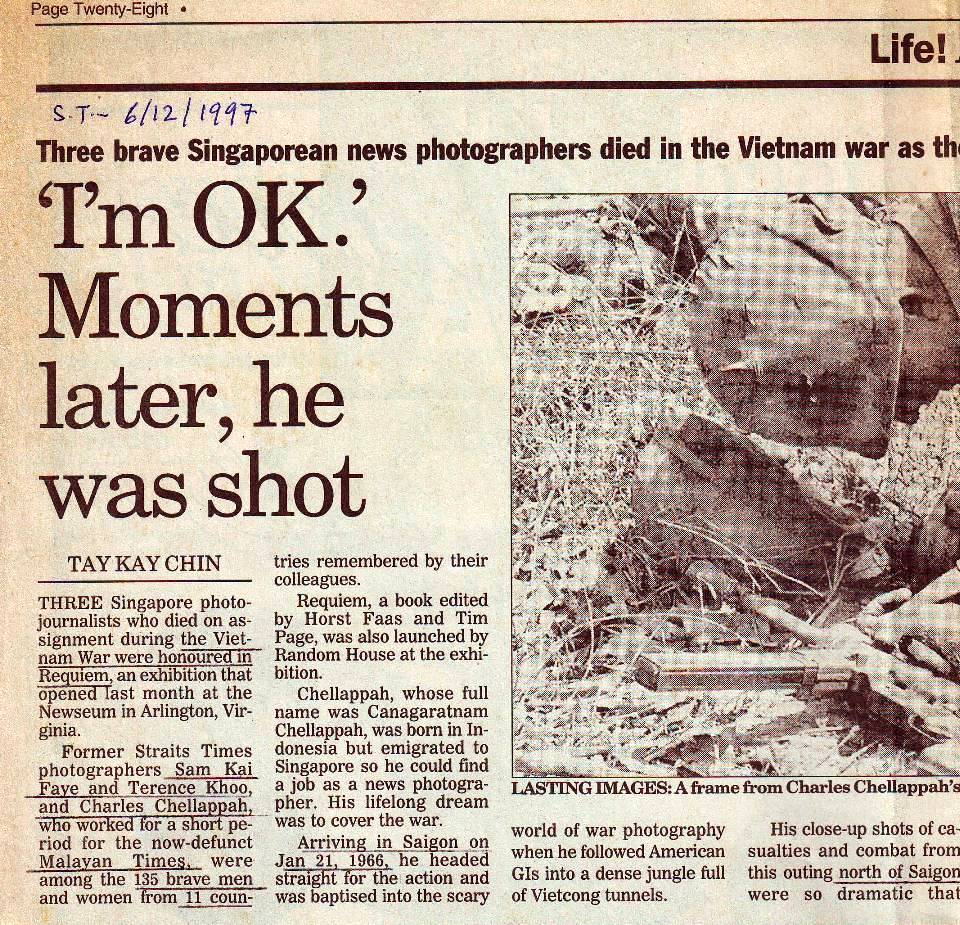
BELOW is the full transcript of the Straits Times Feature Article dated 6 Dec 1997.
'I'm OK .' Moments later, he was shot
THREE Singapore photojournalists who died on assignment during the Vietnam War were honoured in Requiem, an exhibition that opened last month at the Newseum in Arlington, Virginia.
Former Straits Times photographers Sam Kai Faye and Terence Khoo, and Charles Chellappah, who worked for a short period for the now-defunct Malayan Times, were among the 135 brave men and women from 11 countries remembered by their colleagues.
Requiem, a book edited by Horst Faas and Tim Page, was also launched by Random House at the exhibition.

Chellappah, whose full name was Canagaratnam Chellappah, was born in Indonesia but emigrated to Singapore so he could find a job as a news photographer. His lifelong dream was to cover the war.
Arriving in Saigon on Jan 21, 1966, he headed straight for the action and was baptised into the scary world of war photography when he followed American GIs into a dense jungle full of Vietcong tunnels.
His close-up shots of casualties and combat from this outing north of Saigon were so dramatic that Horst Faas, his picture editor at Associated Press, warned him to be more careful.
On Valentine's Day, 1966, he was with a troop on a road-clearing mission when a claymore mine went off. Chellappah and a company commander and medic, went to the rescue of the wounded. A second mine exploded, killing them all.
Just before his death, he had written to his businessman-father about his plan to return to Singapore a month later to start a news photo-agency.
Chellappah was the third AP photographer to die in a year and Faas was ordered to write a report for the president of his agency.
"This last roll of film was released by the authorities today along with his other personal effects," Faas writes in Requiem.
"The pictures show, better than any words could, how close Chellappah was to the action up to the moment of his death."

Sam Kai Faye and Terence Khoo were 48 and 35 respectively when they were killed in a similar incident on July 21, 1972. They were working for American television network ABC at the time and had a lot in common.
Both were former staffers of The Straits Times. Khoo was known for his bravery and suaveness and was frequently in the news.
In the book, Steve Bell, a former ABC correspondent, tells how Khoo had saved his life.
They were both captured in April that year and a Vietcong offered to let Khoo and other Asians go -- but not Bell. Khoo persuaded the soldier that the act would make the Vietcong look bad in the eyes of the world. The argument worked and they were all spared.
Sam had collected many prestigious international journalism awards. Both men were bachelors but Khoo was engaged to marry Winnie Ng, a secretary from his company's Hongkong bureau, at the end of 1972.
After seven years in the trenches, he was to leave for a safe posting to the ABC News bureau in Bonn the next day.

"I was to join him there later," his fiancee said in a newspaper interview at the time, "and we planned to be married there in December."
But he and Sam, his replacement, decided to spend the day on the battlefield instead. It proved to be a fatal decision.
Not long after setting out, Sam was shot by a sniper near Quang Tri. Khoo stayed behind to help him. His last known words to a Korean soundman who managed to escape were: "I'm OK." Moments later, he too was shot. Their bodies were recovered a few days later.
Ali Yusoff, a Straits Times photographer, remembers that the sadness in the newsroom was almost palpable when word of their deaths reached Singapore.
Sam had worked for the paper from 1950 to 1955. Khoo had joined in 1954 and left two years later to freelance.
Sam Yoke Tatt was only a child when his uncle Sam Kai Faye's picture of a plane crash won the top award in an international press photography competition in 1955, but he was well aware of its significance.
"As far as I know, no other Asian has won the award," the nephew said.
When his uncle died in 1972, Yoke Tatt was in his early 20s. He brought his uncle's casket back from Saigon. For many years, Yoke Tatt helped his late father, ex-Straits Times photographer Sam Kai Yee, in their family business.

Khoo's mother, Sim Geok Kee, who was 73, described him in a newspaper interview after his death as a "very brave and famous boy" who knew his own mind.
Khoo had bequeathed one-third of his insurance money of $62,500 to the University of Singapore. Yearly awards of $1,300 were given to the medical research fund for good students from poor families.
The first award went to Lim Meng Kin, a final year medical student who later joined the army after his housemanship, rising to the rank of brigadier general.
Now chief executive officer of Health Corporation of Singapore, Dr Lim was filled with deep emotion when asked about the man who had helped him but whom he knew little about. "Yes, I was one of his beneficiaries," he said, "and I'm very grateful to him."
He said the little he knew about Khoo came from newspaper reports and a small write-up in the scholarship prospectus.
"I met somebody who knew the family and was hoping to meet and thank them personally," he said emotionally, "but the opportunity did not arise."
Apart from Khoo's bequest, ABC, the US TV network Khoo and Sam had worked for, also set up fellowships for Asians to study at Columbia University's Graduate School of Journalism.
Footnote
Shortly after the article appeared, family members of Charles Chellappah called to point out a few discrepancies in this article.
Chellappah, according to his younger brother, Kandasamy, was born and raised in Singapore. (The book said he was born in East Indies, which later became part of Indonesia.)
The family also believes that he was killed by a sniper bullet instead of claymore mine explosion. His elder sister remembers his body was very much intact, apart from a severed face, which would have been impossible if he had been killed by the mine.
Attempts to contact the family before the publication of this article was futile as there were very few reports about Chellappah.
The author apologises unreservingly for the errors.


Of the 3 brave Singaporeans who were killed, I clearly can recall seeing the photos and pictures
of Terence Khoo and Sam Kai Faye in the Straits Times and elsewhere...before July 1972.
Both were really well-known during those days before their sudden and unexpected deaths.
I wonder if anyone knows whether the legacy left behind by Terence Khoo for the University
of Singapore to sponsor good medical students from poor families...still exists today.
It's more than 38 years since.

Was it fate that played a cruel hand for the both of them on that fateful day in July 1972?
Terence was supposed to leave the very next day for Bonn, Germany.
Sam was his replacement photographer.
Despite that day being his final day in Vietnam, Terence decided ( fatally ) to go into the
battlefield and show Sam around.
Just consider this, Terence must have gone on many field operations months before to bring
us his "top action" pictures. The battles he witnessed and captured from the frontlines on those days may have been even more dangerous than that day he was killed. Yet, though he was captured by the Vietcong, he came through safely.
With this blogpost, I hope my younger visitors will have a better insight and understanding
of the dark days of the Vietnam War which claimed the lives of 3 truly BRAVE Singaporeans.
May their souls rest in peace.