Wednesday, March 31, 2010

The Maria Hertogh Saga....Final Part 8, Pulitzer Prize Winner James A Michener wrote about Mansor Adabi


Tribute : JAMES A MICHENER ( Source: Wikipedia )
On the evening of September 14, 1998, the Raffles Hotel in Singapore named one of their suites after the illustrious author, in memory of his patronage and passion for the hotel. Michener first stayed at the Singapore hotel just after World War II in 1949, and in an interview a decade before his death he said it was a luxury for him, a young man, to stay at the Raffles Hotel back then, and had the time of his life. It was officially christened by Steven Green, then Ambassador of United States to Singapore, who noted the writer's penchant of describing 'faraway places with strange-sounding names' to his American book readers. His last stay was in 1985 when he came to Singapore for the launch of the book Salute to Singapore, for which he wrote the foreword. He was so fond of his last stay in Raffles that he took the hotel room key home with him as a souvenir. The suite contains a selection of Michener's works, like Caribbean, The Drifters and Hawaii, as well as two photographic portraits of the author taken at the hotel and in Chinatown in 1985. After his death, the Michener estate corresponded with the hotel management to return the room key, and from there the idea to name the hotel room after him, came into fruition. The souvenir key was duly returned to the hotel, and now on display in the Raffles Hotel Museum
James A. Michener Art Museum

James Michener was one of the literary great of American literature. At the age of 40, and with his first book, "Tales of the South Pacific", he was awarded the 1948 Pulitzer Prize for Fiction. He was a roving reporter covering many parts of Asia, the Pacific and the world. He was also a prolific writer having written more than 40 books.
He died at the age of 90 and was greatly honoured for all his achievements, accomplishments and great charity. He has been featured on USA stamps too.

The reason why I chose to highlight him here in this final Mansor Adabi and Maria Hertogh saga story is because few people anywhere would know about this fact today...... James Michener actually came to Singapore in 1950 to look for Mansor Adabi whom he wish to interview for his published column " Tales of South Asia " in the Milwaukee Journal ( a daily newspaper ).
When Michener asked around, in December 1950, just after the riots had passed and things have quietened down, he was advised, probably by those in the know...not to pursue or locate Mansor Adabi. His detractors felt the subject was perhaps too sensitive to touch on in the open.
Obviously, the great man felt otherwise.
He did locate Mansor Adabi and conducted a face to face interview with him about the whole saga.
In his most intriguing report Michener said, " Mansor Adabi was one of the most provocative and yet winning persons I was to meet in Asia" ( 1950 interview ).

Visitors of my blog can click on the link below to read the FULL story at the Milwaukee Journal of May 2 1951. This is a live, free digital online journal and you can enlarge the text, scroll up and down, turn pages, zoom in or out etc.
The Heading of the story : "Tells of Thwarted Love that led to Fatal Riots ".


http://news.google.com/newspapers?nid=1499&dat=19510502&id=sAMaAAAAIBAJ&sjid=iyMEAAAAIBAJ&pg=4945,292817

Tuesday, March 30, 2010

Maria Hertogh Saga...part 7 ( Her last message Youtube)

This was the last recorded message from Maria Hertogh ( also known as Nadrah ) in May 2009.

She was actually involved in a movie production about her life story last year.

Sadly Maria lost her battle with luekemia just 2 months later on 8 July 2009.

Before her demise, she had left instructions that there was to be no funeral as she had decided to donate her body for medical research.

RIP....Maria alias Nadrah.

Maria Hertogh Saga...part 6


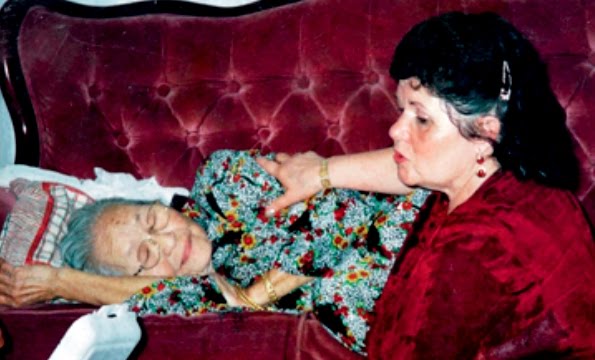
Photo: Maria with her adopted sister in Kemaman, Trengganu 1999

After Maria was taken back to Holland in 1950, she eventually was reintegrated into the Roman Catholic faith. With marriage came children and the raising of a big family. However, she had never forgotten her adopted Malayan homeland especially her kampong friends whom she grew up with in Kemaman, Trengganu. She had longed especially to see Che Aminah her foster mother again. But times were hard and financial considerations did not allow this to happen.
It was sad that Che Aminah passed away in 1976 without seeing Maria again.

Then in 1999, Maria's dream of returning to her kampong days were fulfilled. She was in the news again when she made that eventful trip to meet up with her kampong friends ( those that were left...and there were many who still remembered her and vice-versa, with great fondness and nostalgia ). Maria also met up with Che Aminah's family, including an adopted sister who was actually Japanese ( as seen in the photo above). They were together in the kampong after the war until 1950.

Maria's gripping life story has been the subject of many books, plays and even movies.
When I did some basic research on the internet I was especially glad that quite a number of our schools had their students doing presentations and projects based on not only Maria's story but the lessons that can be learnt from the whole saga. They had compiled their own video clips or photos found in the net and other places to showcase their viewpoints.

Then on July 10, last year, I got quite a shock when I saw this piece of breaking news on Straits Times online.
The main character in this historical saga has finally departed the scene where, for more than a time, she was on the world's foremost stage and attention.

Breaking News > Singapore > Story
July 10, 2009
Maria Hertogh dies


Born in 1937 in Java, Ms Hertogh (above) was adopted by a Malay woman during World War II when she was five years old. -- ST FILE PHOTO


KUALA LUMPUR -


THE young Dutch girl at the centre of a highly publicised custody battle that sparked the 1950 Maria Hertogh riots has died, Bernama reported on Thursday.
Ms Hertogh died of leukaemia in Huijbergen, the Netherlands, on Wednesday. She was 72.
In 1950, when the High Court in Singapore awarded custody of the 13-year-old girl back to her biological Catholic Dutch parents, the ruling ignited three days of riots. Eighteen people were killed and 173 injured.
Ms Hertogh's name has come up in issues involving race and religion in Singapore ever since.
Last month, Deputy Public Prosecutor Anandan Bala raised the spectre of the Maria Hertogh riots when he pushed for jail terms for a Christian couple sentenced to eight weeks in prison for distributing and possessing seditious publications.
Born in 1937 in Java, Ms Hertogh was adopted by a Malay woman during World War II when she was five years old. Her parents had been interned as prisoners of war after the Japanese invaded Java.
The little girl was brought up as a Muslim and took on a Malay name, Nadra Ma'arof. Troubles began when the Hertoghs tried to claim their daughter back after the Japanese surrendered.
What followed was a legal tussle between the Hertoghs and Cik Aminah, Ms Hertogh's foster mother, which played out for more than half a year under intense media scrutiny.
In mid-December 1950, Maria and her mother left Singapore for the Netherlands.
Learning from the lessons of one of the worst race riots in Singapore, the Singapore Government chose to emphasise multi-culturalism and the importance of race relations.
Read the full story in Friday's edition of The Straits Times.


Note to all visitors...some images, photos may be missing!

Blogger is temporary experiencing some technical glitch.

Many bloggers are currently reporting that photos and images from their blogs
have vanished!
That includes MY blog too....!
I have reported the issue to Blogger Help Forum and will patiently await their
solution to the problem.

So if visitors do not see any photos here and there....don't worry.
We are aware of the glitch and hope it will be only temporary.

Regards

Unk Dicko

Friday, March 26, 2010

Fess Parker.....Daniel Boone TV theme song

Ps: Do remember to turn off the music on my Jango jukebox first.

Otherwise a double sound is the result.

Remembering FESS PARKER....as Davy Crockett

Over the last decade and more, many celebrated Hollywood stars known to people of my generation have sadly passed on. Some were legends in their own right. Others will always be remembered or associated with a particular person or role they portrayed in their film that stood out so well that it was indeed very difficult to separate the actor from the legend he was portraying on TV or in the movies.
Think of the musical "The King and I" and Unk Dicko always see bald-headed Yul Brynner's face in his mind's eye. Think back to the days of Tarzan and Jane with all the swinging from tall vines to taller vines, accompanied by the dreaded sounds of the "tom-tom" drums somewhere in dark Africa and I can only see Johnny Weissmuller's Tarzan-like face. No doubt, there were maybe 5 or 6 actors who had played that role before, all reasonably good-looking but not one of them except for Weissmuller, had that "perfect" look of what Tarzan should look like.
It's kind of hard to explain but I suppose Walt Disney himself exemplified this talent for spotting best when he first laid eyes on FESS PARKER and exclaimed, " That's our Davy Crockett ! "
And millions upon millions of Americans kids who grew up from the mid 50's and 60's clearly loved Fess Parker in his portrayal as Davy Crockett and later as Daniel Boone with his raccoon top.
An entire generation in America after the tiredness of the Wars were in search of National heroes to revitalise and guide their new-found consciousness. Hollywood and the movie industry were the perfect channels to recapture the imagination of the American people, especially the young.
As for me, Fess Parker became my hero figure in the form of Crockett and Boone since the 60's.
He embodied everything that is good...fighting for survival, for justice, for good over evil.
He has remained a hero for me to this day. His memory will always remain.
R.I.P
I leave you with this original "The Ballad of Davy Crockett" sung by Fess Parker himself.
We used to sing it in our younger days ( I still sing it today!).

Ps: Do remember to turn off my Jango Jukebox before playing this video.
Otherwise you will have double sounds.

Wednesday, March 24, 2010

Maria Hertogh saga ...part 5


Photo: Maria Hertogh arriving at Schipol Airport, Netherlands

The Aftermath
In the aftermath of those dark and terrible days, the police detained 778 people for investigation
into their involvement in the riots and the killings. One of those detained was Karim Ghani the Muslim activist from Rangoon. Of these number 200 were later charged. Only 100 were convicted while 5 rioters were sentenced to death for "wanton killing".
However the 5 condemned persons were not hanged and had their death sentence commuted to life imprisonment. For this escape of the hangman's noose they had the Tunku to thank.
On 25 August 1951, Tunku Abdul Rahman ( who would be the 1st Prime Minister of the new Federation of Malaya later) became President of UMNO...a Malay/Muslim political party in Malaya. He set out to try to save the 5 condemned men by first gathering enough support from the Muslim population and then pressured the British authorities to commute the sentences. The British were on the tail end of their far-east rule and realised that their time was coming to a close. They did not relish leaving behind grim memories. So Tunku won the day.

The Commission of Inquiry ( source: Wikipedia )
A Commission of Inquiry was appointed by Governor Franklin Gimson. It was headed by Sir Lionel Leach, a member of the Judicial Committee of the Privy Council. The Commission placed large blame on the police command for not having anticipated the violence from many indicators between 2 and 11 December. Furthermore, when the riots first started, the police failed to act promptly to disperse the crowd. The Gurkha contingent standing by was not put into action, while too much dependence was placed on Malay policemen, many of whom defected or at least hesitated to carry out their duties. The British House of Commons criticised the colonial government for its poor handling of the situation.
Present day Government of Singapore also attributed the tragedy to the insensitivity of the colonial government towards the racial and religious feelings of the locals. It cites the incident as a vital lesson learnt in the importance of racial and religious understanding and harmony. It also cites the incident as a case for placing a certain degree of governmental control on the media, especially when racial or religious issues are implicated.

Epilogue ( Source: Wikipedia )
On the night the riots broke out, Maria Hertogh was moved out of the convent, where the rioters tried twice to march on and were only kept back by the police. Plans were made at York Hill to receive her but she was instead sent to Saint John's Island, an offshore island 4 miles south of the main island of Singapore. The next day, Maria and Adeline Hertogh departed for the Netherlands by aeroplane. After landing in Schiphol Airport, they quickly proceeded to the Hertogh home on the outskirts of Bergen op Zoom.
At first, Maria could only talk to her mother, the only one in the family who understood Malay. She demanded rice with every meal, resenting the western diet. She continued to say her Muslim prayers five times a day. In addition, a policeman in plain clothes was assigned to escort her whenever she left the house, for fear of possible kidnappers who might take her back to Singapore, following reported sighting of "oriental strangers" around town. The house was also placed under surveillance.
Slowly, Maria began to adjust to her new environment. A nun came to the house daily to teach her Dutch until she was proficient enough to attend a local convent school. She also began to attend Mass with her family. Back in Singapore, Aminah and Mansoor had apparently given up hope of retrieving Maria after leave to appeal to the Privy Council was not granted. Earlier interest of the several Muslim groups involved had also gradually died down.
On 20 April 1956, Maria was married to Johan Gerardus Wolkefeld, a 21-year-old Dutch Catholic. On 15 February 1957, she gave birth to a son, the first child of ten. However, Maria did not seem to be contented. As she told De Telegraaf, she often had rows with her mother, who lived near by. She also said she still longed for her Malayan homeland. Johan and Mansoor began corresponding. In letters both expressed wish for Maria to travel to Malaya to visit the aged Aminah, but such trip was never made due primarily to financial difficulties. Aminah died in 1976.
The life story of Maria took another dramatic turn on 16 August of the same year, when Maria found herself on trial in a Dutch court charged with plotting to murder her husband. She admitted in court that she had been thinking about leaving her husband but was afraid to start

divorce proceedings in case she lost custody of her children. She came into contact with two regular customers at her husband's cafe bar. The trio bought a revolver and recruited a fourth accomplice to carry out the actual murder. However, the latest member got cold feet and gossiped about the murder plan. The police quickly learnt of it and arrested all four conspirators.
In her defence, Maria's lawyers brought up her background, which the court acknowledged. With this in mind, and because the plot was never executed and there was no proof that she offered any inducement to the other three, the three-man bench acquitted Maria. Meanwhile, Maria had also filed for divorce on the grounds of the irreparable breakdown of her marriage.

Death
On 8th of July 2009, Maria Hertogh died at her house in Huijbergen at the age of 72. The cause of her death was the Leukemia from which she had been suffering.


Maria was raised as a Muslim in Kemaman, Trengganu.
Photo: Her schooling days ( girl circled)

Above : A news report from long ago


Above: A more recent report.
Al Mansor Adabi
As mentioned in my earlier blogpost, Mansor Adabi passed away on 15 October 1988 from a heart attack. He was aged 60. At the time of the story in 1950, he was then a trainee teacher attached to Bukit Panjang Government School having been posted to the school in 1948.
He was born in Kelantan and had his early schooling there. During the War while Singapore was under Japanese occupation, he went to a school called Sihan-Gakko. After the War ended, he continued his schooling in Victoria School, Singapore. Mansor was a scout and later as a teacher became a scoutmaster of Victoria's famous " 6th Arrow Scout Group ".
That was my direct link to dear Mansor as I played an almost similar role to his in the same Scout Troop, same alma mater.
Unk Dicko first met him from the early 1960's.
In all the years I knew him, I found him to be unbelievably soft-spoken, mild mannered, gentle
and highly regarded by one and all ...in short, a perfect gentleman. He carried himself very well and as far as I know, did not allow the past saga of 1950 to weigh him down.
In those early days, his family lived at Kampong Wak Tanjong where many Malays used to live.
I know that kampong well as it was not too far from where I used to grow up in Siang Lim Park, Geylang. That kampong is no longer existing today.
Mansor's father was the well-known writer and nationalist...A Kadir Adabi.
His mother was Che Wok Adabi, an old friend of Che Aminah ( Maria's foster mother ).
Mansor was later married to Zaiton Juhairi. He had 4 children ( a daughter and 3 sons) and 3 grandkids at the time of passing.
NB: There are 3 more parts after Part 5. Just click on the month of March and Part 6, 7, and the concluding Part 8 is there.
Happy Reading!
Unk Dicko